


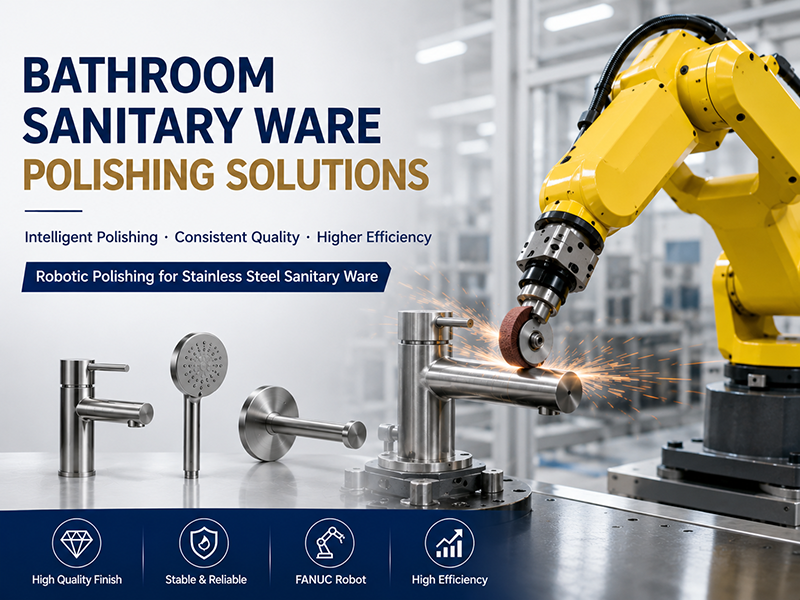

Cast Iron Grinding Machine: Tackling Heavy-Duty Surface Finishing
Table of Contents
- Why Cast Iron Grinding Is Different from Other Metals
- Types of Cast Iron and Their Grinding Challenges
- Manual vs. Automatic Cast Iron Grinding: A Cost Reality Check
- How Automatic Cast Iron Grinding Machines Work
- Grinding Wheel Selection for Cast Iron
- Dust Extraction and Safety Compliance
- ROI and TCO Analysis: When Does Automation Pay Off?
- Case Study 1: Vietnam Automotive Foundry
- Case Study 2: Turkish Valve Manufacturer
- Choosing the Right Cast Iron Grinding Machine
- Frequently Asked Questions
Cast iron remains one of the most widely used engineering materials worldwide — from brake discs and engine blocks to pipe fittings and machine tool bases. Yet finishing cast iron surfaces presents challenges that most general-purpose grinding machines simply cannot handle. The material's abrasive graphite content, variable hardness across casting sections, and the persistent presence of sand residue from molding processes demand purpose-built grinding solutions.
For factory owners in automotive, valve, and machinery industries, the question is no longer whether to automate cast iron grinding, but how quickly they can make the transition. This guide covers everything you need to know about cast iron grinding machines — from material science fundamentals through real ROI calculations and factory case studies from Vietnam and Turkey.
Key Takeaways
- Cast iron's graphite flakes and silica contamination cause 3-5x faster wheel wear than steel grinding
- Automatic machines achieve Ra 0.8μm consistently vs. Ra 1.6-6.3μm with manual grinding
- Typical ROI in 12-16 months based on $40,000-$70,000 annual labor savings
- Dust extraction with HEPA H13 filtration is mandatory for silica-containing operations
1. Why Cast Iron Grinding Is Different from Other Metals
Steel, aluminum, and brass each respond predictably to grinding. Cast iron does not. Understanding why requires looking at three fundamental material characteristics:
Graphite Content Acts as a Built-In Abrasive
Gray iron contains 2.5-4% free carbon in the form of graphite flakes. These flakes are harder than most grinding wheel bonding materials. During grinding, graphite particles act as micro-abasives that accelerate wheel wear by 3-5x compared to carbon steel of similar hardness. This is why a grinding wheel that lasts 3,000 parts on steel may only survive 800-1,200 parts on gray iron.
Variable Hardness Across Sections
A single cast iron part can exhibit hardness variation of HB 30-60 across different sections due to variable cooling rates during casting. Thick sections cool slowly, producing softer, more graphite-rich areas. Thin sections cool faster, forming harder, pearlite-dominant areas. An automatic grinding machine with adaptive force control compensates for these variations in real-time — something a human operator simply cannot do consistently.
Sand Residue from Molding
Virtually all sand-cast iron parts retain some mold sand (silica) on their surfaces. Silica (SiO₂) is extremely abrasive — harder than aluminum oxide grinding grains. When this sand is ground without adequate dust extraction, it creates both a health hazard (crystalline silica dust) and accelerated wheel wear. Professional cast iron grinding machines integrate dust extraction systems designed specifically for this dual challenge.
Brittle Fracture Risk
Unlike steel, cast iron does not deform plastically before failing. Excessive grinding pressure can cause sub-surface cracking, micro-fractures at edges, or even catastrophic chipping of thin features. This is particularly critical for ductile iron (nodular iron) parts used in safety-critical applications like automotive suspension components. Automatic grinding machines maintain consistent pressure within tight tolerances (typically ±5N), eliminating the risk of pressure-induced damage.
2. Types of Cast Iron and Their Grinding Challenges
Not all cast iron is the same. The grinding parameters, wheel selection, and achievable surface finish vary significantly across the five major types. Understanding these differences is essential before selecting any grinding equipment.
| Cast Iron Type | Hardness (HB) | Graphite Form | Key Grinding Challenge | Achievable Ra |
|---|---|---|---|---|
| Gray Iron (ASTM A48) | 120-180 | Flake (random) | Rapid wheel wear from graphite flakes | Ra 0.8-1.6μm |
| Ductile Iron (ASTM A536) | 170-230 | Nodular (spherical) | Higher hardness, less lubricating graphite | Ra 0.4-0.8μm |
| Malleable Iron (ASTM A47) | 130-200 | Temper carbon clusters | Inconsistent surface due to decarburized skin | Ra 0.8-1.6μm |
| Compacted Graphite (ASTM A842) | 180-250 | Vermicular (short worms) | Hardest to grind; mixed flake-nodule structure | Ra 1.6-3.2μm |
| White Iron (ASTM A532) | 400-600 | No free graphite | Extreme hardness; requires CBN or ceramic wheels | Ra 0.4-0.8μm |
Gray iron dominates global casting production (approximately 70% of all iron castings by weight). Its flake graphite structure provides self-lubrication during grinding but accelerates wheel wear. Most foundries grinding gray iron parts (pipe fittings, machine bases, brake drums) report the highest volume but shortest wheel life.
Ductile iron is the fastest-growing segment, replacing gray iron in automotive and hydraulic applications due to its superior tensile strength and impact resistance. The nodular graphite structure is less aggressive to grinding wheels, but the higher base hardness (up to HB 230) demands higher spindle power and more aggressive grit specifications.
Important: Know Your Iron Before Specifying a Machine
Many factories order grinding machines without specifying the exact iron type they process. This leads to mismatched spindle power, incorrect wheel specifications, and disappointing surface finish results. Always inform your equipment supplier of: (1) primary iron type, (2) target hardness range, (3) part geometry and dimensions, and (4) required Ra specification.
3. Manual vs. Automatic Cast Iron Grinding: A Cost Reality Check
The debate between manual and automatic grinding is less about quality (automatic always wins on consistency) and more about cost structure. Let's break down the real numbers for a medium-sized foundry processing 500 ductile iron castings per day.
(8 workers × $775/month)
Reject Rate
(at $8.50/piece)
(automatic investment)
| Parameter | Manual Grinding (8 Workers) | Automatic Grinding (2 Operators) | Advantage |
|---|---|---|---|
| Labor Cost/Year | $62,400 (8 × $650/month) | $15,600 (2 × $650/month) | Save $46,800 |
| Throughput | 500 parts/day (62.5/worker) | 550-600 parts/day (275-300/operator) | +10-20% capacity |
| Surface Finish (Ra) | 1.6-6.3μm (inconsistent) | 0.8-1.6μm (consistent) | 2-4x improvement |
| Reject Rate | 4.2% (21 parts/day) | 0.8% (4-5 parts/day) | 81% reduction |
| Annual Scrap Cost | $28,200 (at $8.50/reject) | $5,400 | Save $22,800 |
| Dust Exposure | High risk (OSHA non-compliant) | Enclosed with HEPA extraction | Regulatory compliant |
| Wheel Consumption | 12 wheels/month (over-grinding) | 6 wheels/month (optimized dressing) | 50% wheel savings |
| Machine Investment | Hand grinders ($3,500 total) | Automatic cell ($85,000-$110,000) | Higher upfront cost |
| Net Annual Savings | — | $46,800 + $22,800 - depreciation | $62,400/year |
The math is compelling: a typical cast iron foundry saves $62,400 annually by automating grinding operations. At a machine cost of $85,000-$110,000, the payback period is 14-18 months — even before factoring in reduced health insurance costs, lower workers' compensation premiums, and improved customer satisfaction from consistent quality.
4. How Automatic Cast Iron Grinding Machines Work
Modern automatic cast iron grinding machines integrate several technologies that work together to deliver consistent results on a notoriously difficult material. Here is a breakdown of the core systems:
Spindle System
Cast iron grinding demands high-torque spindles. A typical configuration uses a 7.5-15 kW (10-20 HP) spindle operating at 2,800-4,500 RPM. The spindle must handle significant vibration loads because cast iron's variable hardness creates intermittent cutting forces. Belt-driven spindles with damping mechanisms are preferred over direct-drive configurations for cast iron applications, as they absorb shock better.
Force Control Technology
Force control is the single most important technology for cast iron grinding. A force sensor (typically piezoelectric) monitors contact pressure between the grinding wheel and the workpiece at a rate of 1,000 times per second. The control system adjusts feed rate and spindle power in real-time to maintain constant pressure — typically 20-80 N depending on the operation. This prevents over-grinding on soft sections and under-grinding on hard sections of the same part.
Multi-Axis Positioning
Most cast iron parts have complex 3D geometries — intake manifolds, valve bodies, pump housings. An automatic grinding machine uses 4-6 axes of controlled motion to follow part contours. For flat surfaces and simple edges, 4-axis machines (X-Y-Z + rotary table) are sufficient and more cost-effective. For complex internal surfaces, 6-axis configurations provide the necessary reach and dexterity.
Part Clamping and Fixturing
Cast iron parts are heavy and abrasive. Fixturing must clamp securely without damaging machined reference surfaces. Pneumatic toggle clamps with replaceable copper or Delrin jaws are standard. For high-volume applications, quick-change pallet systems allow loading one part while another is being ground, maximizing spindle utilization.
Programmable Grinding Parameters
A modern CNC grinding controller stores parameter profiles for each part number. A profile includes: grinding wheel specification, spindle speed, feed rate, force setpoint, dressing intervals, and expected cycle time. Switching between part profiles takes 3-5 minutes on a well-programmed machine. This enables mixed-model production — running different cast iron parts on the same machine throughout the day.
5. Grinding Wheel Selection for Cast Iron
Choosing the wrong grinding wheel for cast iron is the single most common source of poor results. The wheel must handle three simultaneous demands: cut through the iron matrix, survive graphite abrasion, and tolerate silica contamination from mold sand. Here are the key specifications:
Abrasive Type
- Silicon Carbide (SiC) — The workhorse for gray iron and malleable iron. SiC is sharper than aluminum oxide and fractures more readily, exposing fresh cutting edges. Grades C46-G60 (46-60 grit) are most common.
- Aluminum Oxide (Al₂O₃) — Preferred for ductile iron and compacted graphite iron where the higher hardness demands a tougher abrasive grain. Grades A46-A80 depending on desired finish.
- Cubic Boron Nitride (CBN) — Used for white iron and chilled iron castings where conventional abrasives fail. Very expensive but lasts 50-100x longer than SiC. Justified only for continuous high-volume production.
Bond Type
Vitrified bonds are the industry standard for cast iron grinding. They provide good porosity for chip clearance (important because cast iron generates short, discontinuous chips that can load the wheel) and maintain wheel shape well. Resin-bonded wheels are used for finishing operations where a softer, more conformable wheel is needed.
Grain Size and Structure
Rough grinding operations use 36-46 grit wheels with a dense structure (8-12). Finishing operations step down to 60-120 grit with an open structure (12-16). The structure number indicates the percentage of wheel volume occupied by abrasive grains — lower numbers mean denser wheels that hold form better but cut slower.
Cost Tip: Dressing Optimization
Proper wheel dressing technique can extend wheel life by 30-40%. Use a single-point diamond dresser for form dressing and a rotary diamond roller for rapid reconditioning. Automatic grinding machines typically include programmable dressing cycles — use them. Over-dressing is as costly as under-dressing, consuming 1-2mm of wheel diameter per unnecessary cycle.
6. Dust Extraction and Safety Compliance
Cast iron grinding generates a hazardous dust mixture that factory owners cannot afford to ignore. The dust contains two distinct hazards:
- Iron oxide particles — Fine metallic dust that can cause respiratory irritation and, in extreme cases, siderosis (iron lung). While not classified as a carcinogen, prolonged exposure at high concentrations is dangerous.
- Crystalline silica (SiO₂) — Sand residue from the casting process. Crystalline silica is classified as a Group 1 carcinogen by IARC and is regulated under OSHA's silica standard (29 CFR 1910.1053) and the EU Carcinogens Directive. PEL (Permissible Exposure Limit) is 50 μg/m³ as an 8-hour TWA in the US.
Extraction System Requirements
A compliant dust extraction system for cast iron grinding must meet the following specifications:
- Minimum airflow: 3,000 m³/h at the grinding enclosure capture point, with a face velocity of at least 0.5 m/s.
- Filtration: Two-stage system — cyclone pre-separator for heavy iron particles, followed by HEPA H13 cartridge filters for fine silica dust. Single-stage bag filters are inadequate for silica compliance.
- Spark arrestor: Iron sparks from grinding can ignite dust accumulations. An inline spark arrestor (typically a centrifugal baffle or water-wash system) is mandatory.
- Automatic cleaning: Pulse-jet filter cleaning prevents pressure drop and maintains consistent extraction performance. Cleaning is typically triggered by differential pressure switch at 1,200-1,500 Pa.
- Continuous monitoring: A particulate meter downstream of the HEPA filter provides real-time compliance verification. Alarms trigger when concentrations approach 80% of the PEL.
DZ Smart Manufacturing's automatic grinding machines come with an integrated extraction system as standard, designed to meet both EU ATEX requirements and US OSHA silica standards. This is not optional — it is essential for operator safety and regulatory compliance in any market.
7. ROI and TCO Analysis: When Does Automation Pay Off?
The decision to automate cast iron grinding is ultimately a financial one. Let's model two scenarios — one for a factory in Vietnam (lower labor cost) and one for Turkey (higher labor cost) — to show how ROI varies by market.
Scenario A: Vietnam Foundry (500 parts/day, gray iron pipe fittings)
| Cost Item | Manual (6 Workers) | Automatic (2 Operators) |
|---|---|---|
| Machine Investment | $3,500 (hand tools) | $85,000 |
| Annual Labor Cost | $36,000 ($500/month × 6) | $12,000 ($500/month × 2) |
| Annual Wheel Cost | $4,800 (12/month × $40) | $3,600 (9/month × $40) |
| Annual Scrap Cost | $18,000 (3.5% reject × $8) | $4,200 (0.7% reject) |
| Dust Extraction | $6,000/year (portable units) | Included in machine price |
| Total Annual Operating | $64,800 | $19,800 |
| Annual Savings | $45,000/year | |
| ROI Period | 23 months | |
Scenario B: Turkey Foundry (500 parts/day, ductile iron automotive)
| Cost Item | Manual (8 Workers) | Automatic (2 Operators) |
|---|---|---|
| Machine Investment | $4,200 (hand tools) | $110,000 |
| Annual Labor Cost | $76,800 ($800/month × 8) | $19,200 ($800/month × 2) |
| Annual Wheel Cost | $6,000 (15/month × $40) | $4,200 (10.5/month × $40) |
| Annual Scrap Cost | $31,500 (4.5% reject × $12) | $5,600 (0.8% reject) |
| Dust Extraction | $8,500/year | Included in machine price |
| Total Annual Operating | $127,000 | $29,000 |
| Annual Savings | $98,000/year | |
| ROI Period | 14 months | |
The Turkey scenario achieves ROI in just 14 months — a compelling case for any factory in a medium-to-high labor cost market. Even in Vietnam, where wages are significantly lower, the 23-month payback is well within the 5-year expected machine lifespan, delivering net savings of $117,000+ over the machine's useful life.
8. Case Study 1: Vietnam Automotive Foundry — Ductile Iron Brake Disc Grinding
VinaCast Industries — Hai Phong, Vietnam
Background: VinaCast Industries is a mid-sized foundry in Hai Phong Industrial Zone, supplying ductile iron brake discs to Japanese and Korean automotive OEMs. In 2024, they ground all disc surfaces manually using angle grinders and belt sanders, employing 10 workers on two shifts.
Challenge: The Japanese OEM customer imposed a new Ra specification of ≤ 1.0μm on disc friction surfaces (previously Ra ≤ 3.2μm was accepted). Manual grinding could not consistently meet this spec — reject rates jumped to 8.5%, threatening the supply contract. Additionally, three workers had filed health complaints related to dust exposure, and Vietnam's Ministry of Labour had issued a formal warning.
Solution: VinaCast installed a DZ Smart Manufacturing DZ-CG1500 CNC cast iron grinding cell with integrated dust extraction. The machine was configured with a 4-axis layout (X-Y-Z + rotary table), 11 kW spindle, and force control system set to 35N constant pressure. Two grinding programs were created: rough grind (SiC 46 grit) and finish grind (Al₂O₃ 80 grit), running sequentially in a single cycle.
Results after 6 months:
VinaCast retained the OEM contract and has since ordered a second DZ grinding cell for a new ductile iron hub production line scheduled to launch in Q3 2026.
9. Case Study 2: Turkish Valve Manufacturer — Gray Iron Body Grinding
Anadolu Vana San. — Bursa, Turkey
Background: Anadolu Vana is a family-owned valve manufacturer in Bursa, Turkey's industrial heartland. They produce gray iron gate valves, globe valves, and check valves for export to the EU and Middle East. Grinding was performed by 12 workers using pedestal grinders and hand-held rotary tools.
Challenge: Two critical problems converged in 2025. First, an EU distributor threatened to terminate the contract because 15% of shipments had visible grinding marks and inconsistent surface finish on flange faces. Second, the company faced a 35% worker turnover rate in the grinding department — workers cited dust, noise, and hand-arm vibration as reasons for leaving. Recruiting replacements was increasingly difficult as Bursa's growing automotive industry offered cleaner, safer factory jobs at competitive wages.
Solution: Anadolu Vana invested in two DZ Smart Manufacturing DZ-CG1200 automatic grinding cells, each with a 6-axis rotary fixture system capable of handling 30 different valve body sizes. The machines were fitted with SiC vitrified wheels (grade C60-I8V) and HEPA H13 dust extraction systems to meet EU workplace exposure limits. A quick-change fixture system reduced changeover between valve models to 8 minutes.
Results after 9 months:
The EU distributor renewed the contract with a 20% volume increase. Anadolu Vana's grinding department turnover dropped from 35% to 8% — the remaining 2 operators report significantly better working conditions, and the company has been able to redirect the 10 freed workers to higher-value machining operations.
10. Choosing the Right Cast Iron Grinding Machine
Selecting the right grinding machine for your cast iron operation requires evaluating several parameters beyond the price tag. Here is a structured approach to the decision process:
Step 1: Define Your Production Requirements
- Part types and sizes: Maximum and minimum dimensions, weight range, and number of active part numbers.
- Target throughput: Parts per shift, parts per day, and seasonal variations in demand.
- Surface finish spec: Required Ra range for each critical surface. Some buyers specify Ra directly; others reference standards (ISO 1302, ASME B46.1).
- Iron type and hardness: As discussed in Section 2, this directly affects spindle power and wheel selection.
Step 2: Evaluate Machine Specifications
| Specification | Entry Level | Mid Range | High Performance |
|---|---|---|---|
| Spindle Power | 5.5-7.5 kW | 7.5-11 kW | 11-22 kW |
| Axes | 3-axis (X-Y-Z) | 4-axis (+ rotary table) | 5-6 axis (+ articulating head) |
| Force Control | Open-loop (no sensor) | Single-axis force sensor | Multi-axis force control |
| Part Capacity | Up to 30 kg | Up to 150 kg | Up to 500 kg |
| Program Storage | 50 programs | 200 programs | 500+ programs + networking |
| Dust Extraction | Basic cartridge filter | Cyclone + HEPA H13 | Full compliance system |
| Typical Investment | $40,000-$65,000 | $65,000-$110,000 | $110,000-$200,000 |
Step 3: Assess Supplier Capabilities
Beyond the machine itself, evaluate the supplier on these criteria:
- Application experience: Has the supplier successfully installed machines in similar cast iron grinding applications? Ask for reference customers in your industry.
- After-sales support: Does the supplier offer remote diagnostics, spare parts inventory in your region, and technician deployment within 48 hours?
- Training program: A quality supplier provides operator training (3-5 days), maintenance training (2 days), and programming training for engineers.
- Certifications: CE marking (EU market), ISO 9001 quality management, and safety certifications relevant to your region.
Step 4: Plan the Installation
Allow 6-10 weeks from order to production for a standard grinding cell installation. This includes: factory acceptance testing (FAT) at the supplier's facility, shipping (4-6 weeks by sea), site preparation (foundation, power connection, compressed air), installation and commissioning (5-7 days), and operator training (3-5 days). Request a detailed project timeline and milestone-based payment terms.
Why Choose DZ Smart Manufacturing for Cast Iron Grinding?
- 25 years of expertise in surface finishing automation, with 3,000+ machines installed across 40+ countries
- CE + ISO 9001 certified machines meeting international safety and quality standards
- Dedicated application engineering team that develops grinding programs for your specific cast iron parts before shipment
- Integrated dust extraction meeting OSHA and EU silica exposure limits — no additional equipment purchase required
- 24-month warranty with remote diagnostic support and 48-hour on-site service commitment
11. Frequently Asked Questions
Modern automatic cast iron grinding machines achieve Ra 0.4-1.6μm depending on the application. For most ductile iron and gray iron parts, Ra 0.8μm is the standard target — sufficient for machining-ready surfaces. Manual grinding typically delivers Ra 1.6-6.3μm with high variation. The achievable finish depends on iron type, wheel specification, and the number of grinding passes programmed into the machine.
A high-quality silicon carbide grinding wheel (46-60 grit) typically lasts 800-1,500 parts on gray iron and 500-900 parts on ductile iron before dressing is required. With automatic grinding machines, dressing cycles are programmed, reducing downtime to under 2 minutes per cycle. Total wheel life before replacement is typically 8,000-15,000 parts on gray iron and 5,000-10,000 on ductile iron.
Based on real factory data from Vietnam and Turkey, cast iron grinding automation typically achieves ROI in 12-16 months for medium-to-high labor cost markets. In lower labor cost markets like Vietnam or Bangladesh, ROI extends to 20-24 months but still delivers strong lifetime savings. The key variables are: number of manual workers replaced, local wage rates, and the reject rate improvement from automated quality control.
Yes, but parameter adjustment is critical. Ductile iron is approximately 40% harder than gray iron (HB 170-230 vs. HB 120-180), requiring different spindle speeds, feed rates, and grinding wheel specifications. Modern CNC grinding machines store parameter profiles for each iron type, allowing operators to switch between gray and ductile iron grinding in under 10 minutes. However, grinding wheels must be changed when switching between SiC (for gray iron) and Al₂O₃ (for ductile iron) wheels.
Manual cast iron grinding poses serious hazards: respirable crystalline silica dust (from sand cast molds adhering to parts), flying metal particles at high velocity, hand-arm vibration syndrome (HAVS) causing long-term nerve and circulatory damage, and noise levels exceeding 100 dB. OSHA and EU regulations classify foundry grinding as a high-risk operation requiring extensive PPE, exposure monitoring, and engineering controls — all of which are addressed by enclosed automatic grinding machines.
A standard automatic cast iron grinding cell occupies 3m × 2.5m (approximately 7.5 m²), including the grinding enclosure, dust extraction system, and control cabinet. This is comparable to the space used by 2-3 manual grinding stations. DZ Smart Manufacturing offers compact configurations starting at 2.5m × 2m for space-constrained facilities, with vertical dust extraction to reduce the machine's overall footprint.
Cast iron grinding generates a mix of iron particles and silica dust from mold sand residue. A proper extraction system requires: minimum 3,000 m³/h airflow at the capture point, two-stage filtration (cyclone pre-separator + HEPA H13 cartridges), spark arrestor for fire prevention, automatic pulse-jet cleaning, and continuous particulate monitoring. DZ Smart Manufacturing machines come with integrated extraction systems meeting EU ATEX and US OSHA silica standards as standard equipment.
Ready to Automate Your Cast Iron Grinding?
Get a free assessment of your current grinding operations. Our engineers will analyze your parts, recommend the right machine configuration, and provide a detailed ROI projection specific to your factory.